Library

The Boaz project, in five formats

A book, a research paper (a preprint, submitted for review to ISEC ’27), a magazine-style article, a poster and a slide deck. The book is the source of truth: every number in the shorter pieces is taken from it, and each one keeps the results Boaz lost.

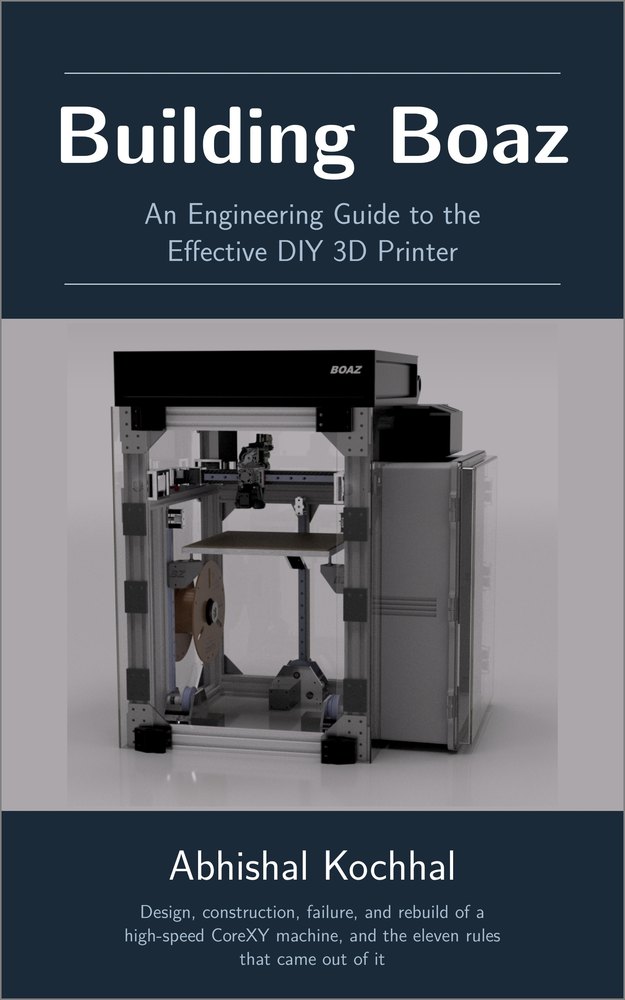
Cover of the book Building Boaz
Book29 chapters2026

Building Boaz

An Engineering Guide to the Effective DIY 3D Printer

The design, construction, failure and rebuild of a high-speed CoreXY machine, and the eleven rules that came out of it. The book covers frame stiffness, motion systems, precision assemblies, the toolhead, the Z axis, electronics and firmware, then the first prints, the diagnosis, and the rebuild, where most of the engineering lives.

Seven appendices include the bill of materials, the Klipper configuration, the metrology procedures and a figure map.

The book is sold through Amazon and is not hosted on this site.

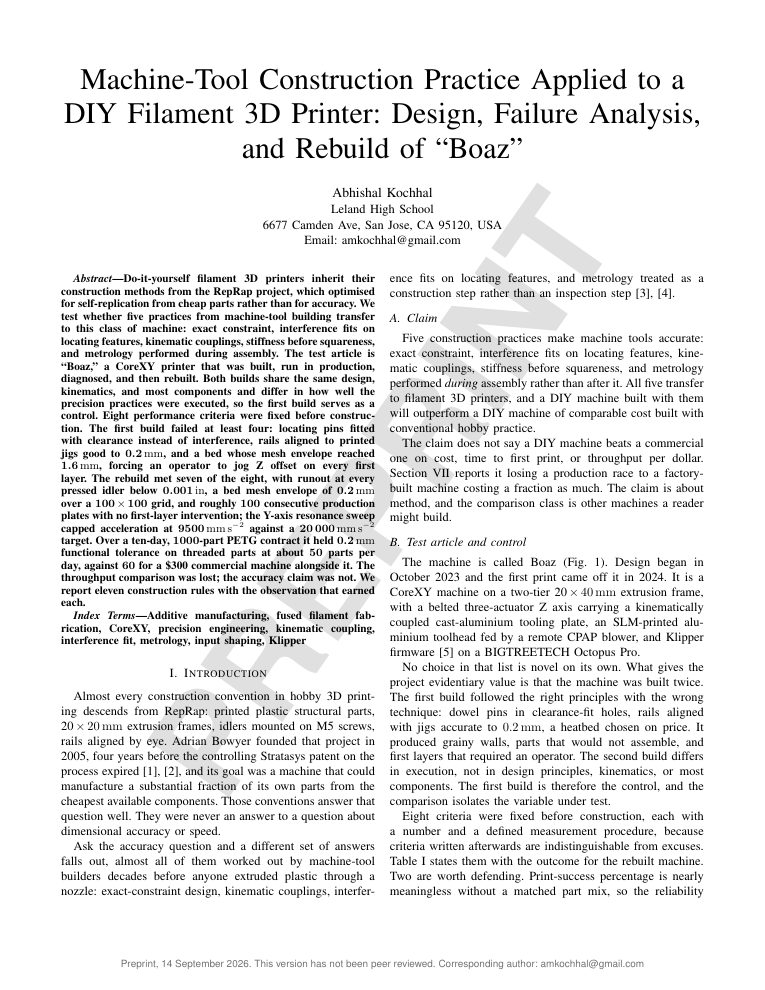
First page of the research paper preprint
Research paperPreprintSubmitted to ISEC ’2713 pagesIEEE format

Machine-Tool Construction Practice Applied to a DIY Filament 3D Printer

Design, Failure Analysis, and Rebuild of “Boaz”

Abstract. Do-it-yourself filament 3D printers inherit their construction methods from the RepRap project, which optimized for self-replication from cheap parts rather than for accuracy. The paper tests whether five practices from machine-tool building transfer to this class of machine: exact constraint, interference fits on locating features, kinematic couplings, stiffness before squareness, and metrology performed during assembly.

The test article is Boaz, a CoreXY printer that was built, run in production, diagnosed, and then rebuilt. Both builds share the same design, kinematics and most components, and differ in how well the precision practices were executed, so the first build serves as a control. Eight performance criteria were fixed before construction. The first build failed at least four. The rebuild met seven of the eight, with runout at every pressed idler below 0.001 in, a bed mesh envelope of 0.2 mm over a 100 × 100 grid, and roughly 100 consecutive production plates with no first-layer intervention; the Y-axis resonance sweep capped acceleration at 9,500 mm/s² against a 20,000 mm/s² target.

Over a ten-day, 1,000-part PETG contract it held 0.2 mm functional tolerance on threaded parts at about 50 parts per day, against 60 for a $300 commercial machine alongside it. The throughput comparison was lost; the accuracy claim was not. The paper reports eleven construction rules with the observation that earned each.

  • Additive manufacturing
  • CoreXY
  • Precision engineering
  • Kinematic coupling
  • Interference fit
  • Metrology
  • Input shaping
  • Klipper

Preprint, under review. This version is dated 14 September 2026 and has not been peer reviewed. The paper has been submitted for review to the IEEE Integrated STEM Education Conference (ISEC ’27).
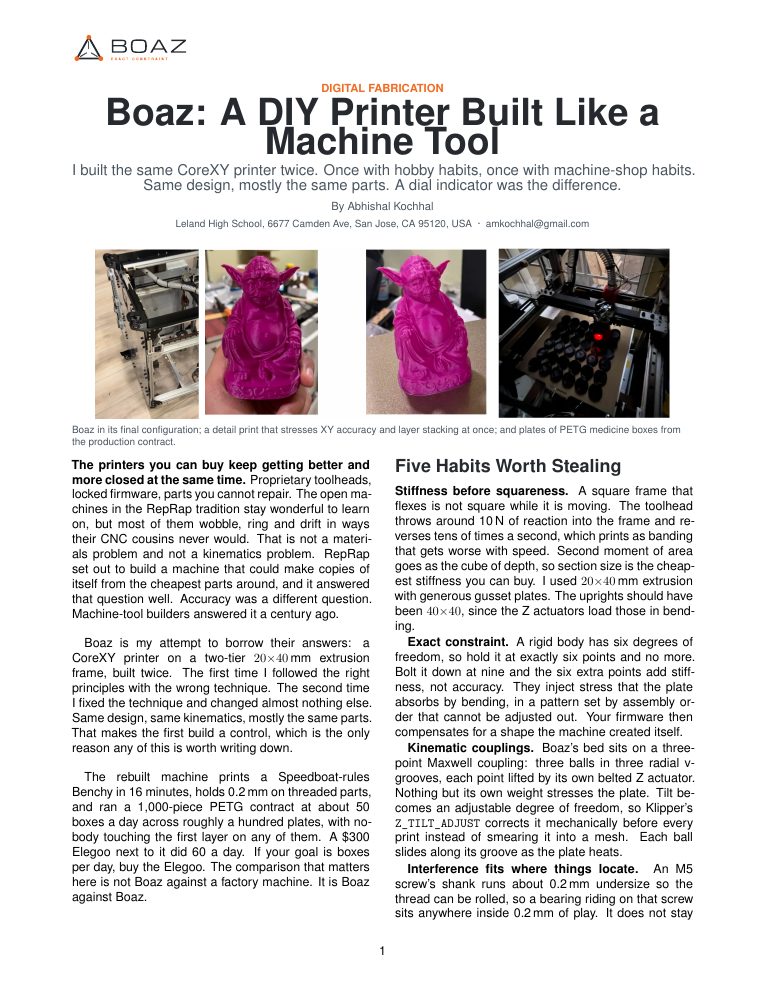
First page of the article Boaz: A DIY Printer Built Like a Machine Tool
Article4 pages2-page cut

Boaz: A DIY Printer Built Like a Machine Tool

A magazine-style feature for makers

“I built the same CoreXY printer twice. Once with hobby habits, once with machine-shop habits. Same design, mostly the same parts. A dial indicator was the difference.”

The article walks through five habits worth stealing, the build fast-forwarded, what broke, and what the numbers say. The two-page cut keeps the same results and caveats in less space.

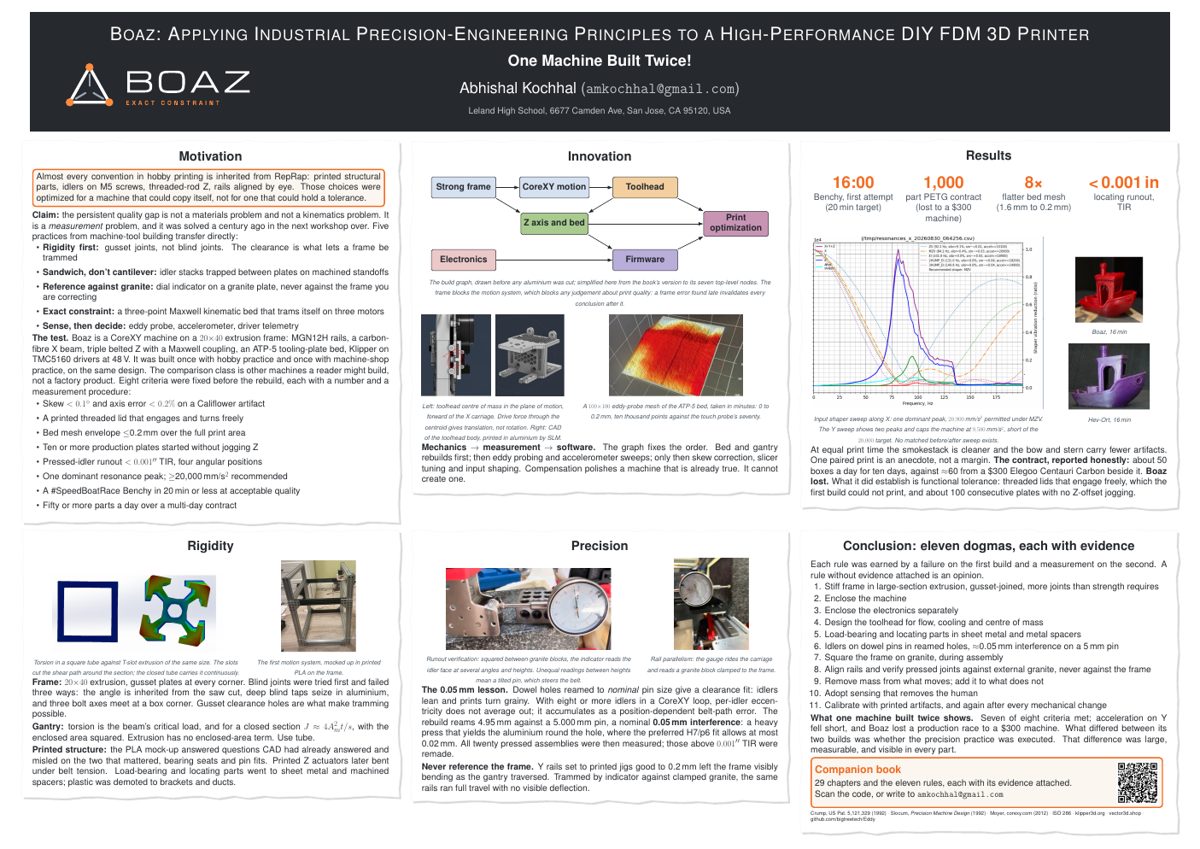
The Boaz conference poster: six blocks covering motivation, innovation, results, rigidity, precision and conclusion
PosterA0 landscape1 page

Applying Industrial Precision-Engineering Principles to a High-Performance DIY FDM 3D Printer

One machine, built twice

Six blocks on one sheet: motivation, innovation, results, rigidity, precision, and the eleven rules. It includes the build graph that fixed the order of work, the bed mesh, the input-shaper sweep and the paired Benchy.

Shown with the machine at Maker Faire Rocklin 2026, Sierra College, October 2026.

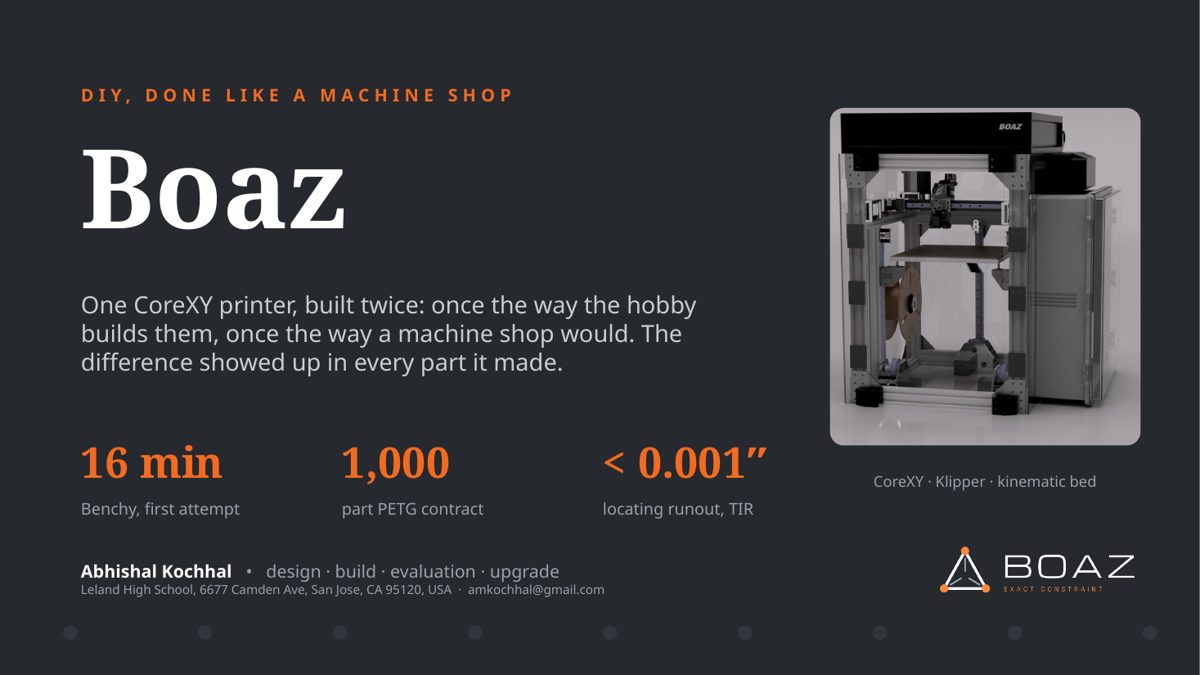
Title slide of the Boaz deck: DIY, done like a machine shop
Slides9 slides

Boaz: DIY, Done Like a Machine Shop

The short version

Why build another printer, five habits borrowed from machine building, the machine at a glance, what broke first, the upgrades that mattered, the numbers, and six of the eleven rules.

Using this work

Questions, corrections or a talk?

All text and images are © Abhishal Kochhal. To quote, reuse or ask about any of it, write to amkochhal@gmail.com.